Street Art in Naples' Neighborhoods
In Naples, even the walls speak. And they don't whisper—they shout, sing, and declare love. Street art here isn't just color on concrete; it's an urban voice emerging from the neighborhoods, narrating dreams, sorrows, memories, and desires. It's a vibrant, pulsating language that accompanies the curious traveler, offering new perspectives on a city in constant transformation.

Quartieri Spagnoli: Maradona, icons, and redemption
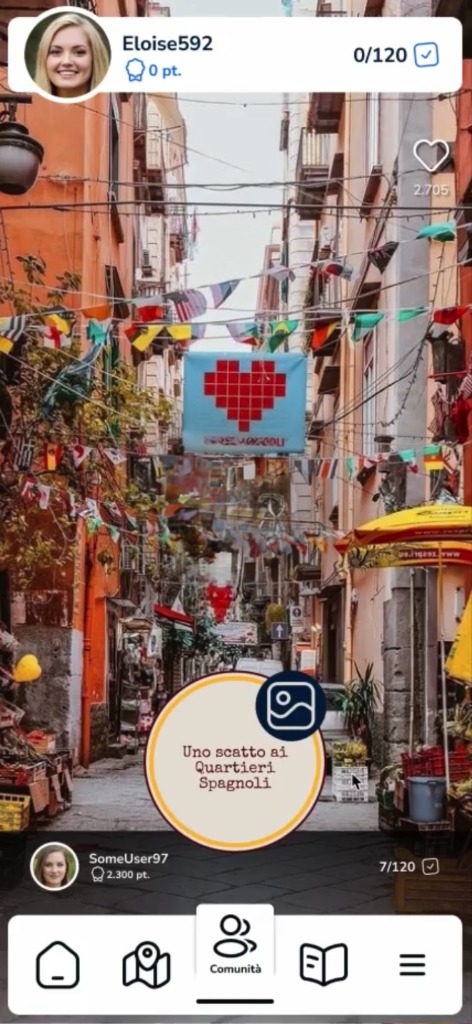
In the vertical maze of the Quartieri Spagnoli, street art is a secular faith. The face of Maradona dominates like an altar in the heart of Via Emanuele De Deo, alongside murals dedicated to Totò, Pino Daniele, and Sophia Loren. Here, every wall tells a popular story: art becomes redemption, beauty claiming space between the everyday and the sacred.
Sanità: community art
In the Rione Sanità, street art is part of a grassroots revival project. Murals like Luce by Tono Cruz and Resis-Ti-Amo by Francisco Bosoletti speak of connections, resistance, and hope. These works, born from dialogue with residents, transform the neighborhood into a collective beauty workshop, where art becomes the voice of social redemption.
Ponticelli: color in the eastern suburbs
In Ponticelli, public housing buildings come alive through the Parco dei Murales, a creative laboratory that has brought monumental works by international artists. Here, street art isn't just decoration; it's visual politics and rootedness. Each piece arises from engagement with local residents, reflecting a collective vision of belonging and hope.
Forcella: art as a statement
In the ancient and fragile heart of Forcella, street art often takes on a tone of protest. Among the alleys, portraits of women, poets, and children emerge. Art becomes a visible presence in places of absence, a means to rewrite the perception of a complex and layered urban space.
Scampia: a new visual narrative
Scampia is now a cultural laboratory. Murals in the neighborhood depict a changing community that self-represents and combats stigma through accessible and inclusive art forms. Projects like Murales per la legalità and works near the Vela Celeste speak of rights, childhood, education, and freedom.
Bagnoli and post-industrial art
In Bagnoli, between the former Italsider plant and the sea, urban art has found space on abandoned silos, peeling walls, and disused architectures. It's art that dialogues with the industrial past and working-class memory, yet looks forward, proposing visionary images for a Naples regenerating from the ground up.
An emotional map of the city
Street art in Naples isn't peripheral; it's central to the city's identity narrative. Each neighborhood paints its own story, using a language that requires no tickets or explanations. Just walk. Look up. Pause. Because in Naples, often, the museum is outside. And it's not just visited; it's lived.